

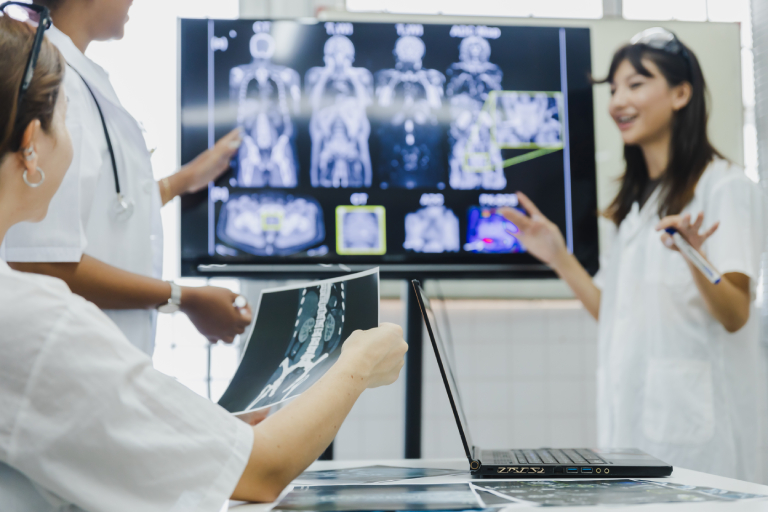

Artificial intelligence (AI) is dramatically improving the accuracy of medical imaging, enabling earlier detection, better diagnosis, and more personalized treatment plans. By analyzing complex imaging data, AI systems help radiologists identify subtle abnormalities that may be missed during traditional review, reducing errors and improving patient outcomes.
AI excels at pattern recognition. Radiology images—X-rays, CT scans, MRIs, and PET scans—contain vast amounts of data that can be difficult for humans to process fully. AI algorithms, trained on millions of annotated images, can detect patterns, textures, and anomalies that may not be immediately visible. This allows radiologists to identify tumors, fractures, and vascular abnormalities with greater confidence.
Automation reduces human error. Even experienced radiologists can experience fatigue, oversight, or bias. AI acts as a “second set of eyes,” highlighting potential areas of concern and providing quantitative analysis such as tumor size, volume, and growth rates. By combining human expertise with AI insights, diagnostic accuracy is significantly enhanced.
Integration with predictive analytics further increases accuracy. AI systems can compare current imaging results with historical patient data, population-level trends, and known disease progression models. This contextual understanding helps radiologists differentiate between benign variations and clinically significant findings, reducing false positives and false negatives.
Real-time processing and workflow support allow faster, more reliable diagnostics. AI algorithms can pre-analyze images as they are uploaded, flag urgent cases for immediate review, and generate preliminary reports. This not only accelerates diagnosis but also ensures critical conditions are addressed promptly, improving patient outcomes.
AI-driven 3D modeling and segmentation improve diagnostic clarity. Advanced imaging software can automatically segment organs, tissues, or lesions and generate three-dimensional reconstructions. This precision is particularly valuable in oncology, orthopedics, and neurology, where exact measurements guide surgical planning and targeted treatments.
Continuous learning and adaptability make AI systems increasingly accurate over time. Machine learning algorithms can update their models as they process more data, improving detection rates across diverse patient populations. Regular validation ensures that these systems maintain reliability and minimize bias.
Challenges and considerations include regulatory approval, ethical use, and explainability. AI outputs must be interpretable so that radiologists understand the reasoning behind recommendations. Ensuring patient data privacy and securing imaging systems against cyber threats are equally critical to maintaining trust in AI-powered diagnostics.








Leave a Comment